Before the dining room lights dim at 120 River Street, and long before the first guests arrive to take their seats beneath the factory casements, there is corn. Everything else on the menu is built on it.
Pre-packaged tortillas sitting on refrigerated shelves rely on preservatives and gums to survive weeks in plastic. A real tortilla has a lifespan measured in minutes.
Made from properly nixtamalized corn and laid across a blistering comal seconds before it reaches the table, a tortilla stops being a simple wrapper. It becomes the heart of the meal.
The Ancient Foundation: 3,500 Years of Nixtamal
To understand the aroma and pliability of a traditional tortilla, you have to look thirty-five centuries back to Mesoamerica.
Raw dried corn cannot simply be pulverized and mixed with water; without processing, the grain yields a brittle, crumbly paste that refuses to hold together. The indigenous peoples of Mexico unlocked the grain through nixtamalization—cooking dried field corn in water steeped with mineral calcium hydroxide (cal, or slaked lime).
This ancient chemical breakthrough accomplishes three essential tasks:
- Unlocks Essential Nutrition: The alkaline steep dissolves the indigestible outer hull (pericarp) and frees bound niacin (vitamin B3), transforming field corn into a complete nutritional staple.
- Creates Natural Elasticity: It restructures the grain’s proteins, allowing the milled flour to absorb warm water and bond into a silky, cohesive dough with zero wheat, gluten, or artificial additives.
- Develops Earthy Complexity: It awakens the deep, toasted, floral aromatics that define authentic Mexican cooking.
When pure heirloom corn is nixtamalized at origin and gently milled into authentic masa harina, that entire 3,500-year lineage arrives intact in our kitchen.
The Craft: Water, Salt, and Touch
Working with nixtamalized masa is fundamentally a craft of feel. It cannot be dictated by rigid formulas or kitchen timers; it must be judged by the hands.
Flour is worked with warm water and salt, and the humidity of the room changes what the dough needs from one day to the next:
- Too wet: The dough sticks to the press liners and tears across the comal.
- Too dry: The edges crack, moisture escapes before it can vaporize, and the tortilla sits flat and dense.
- In its prime: The masa feels cool and supple—like soft clay that yields instantly to gentle pressure, holds its shape, and pulls away cleanly from the skin.
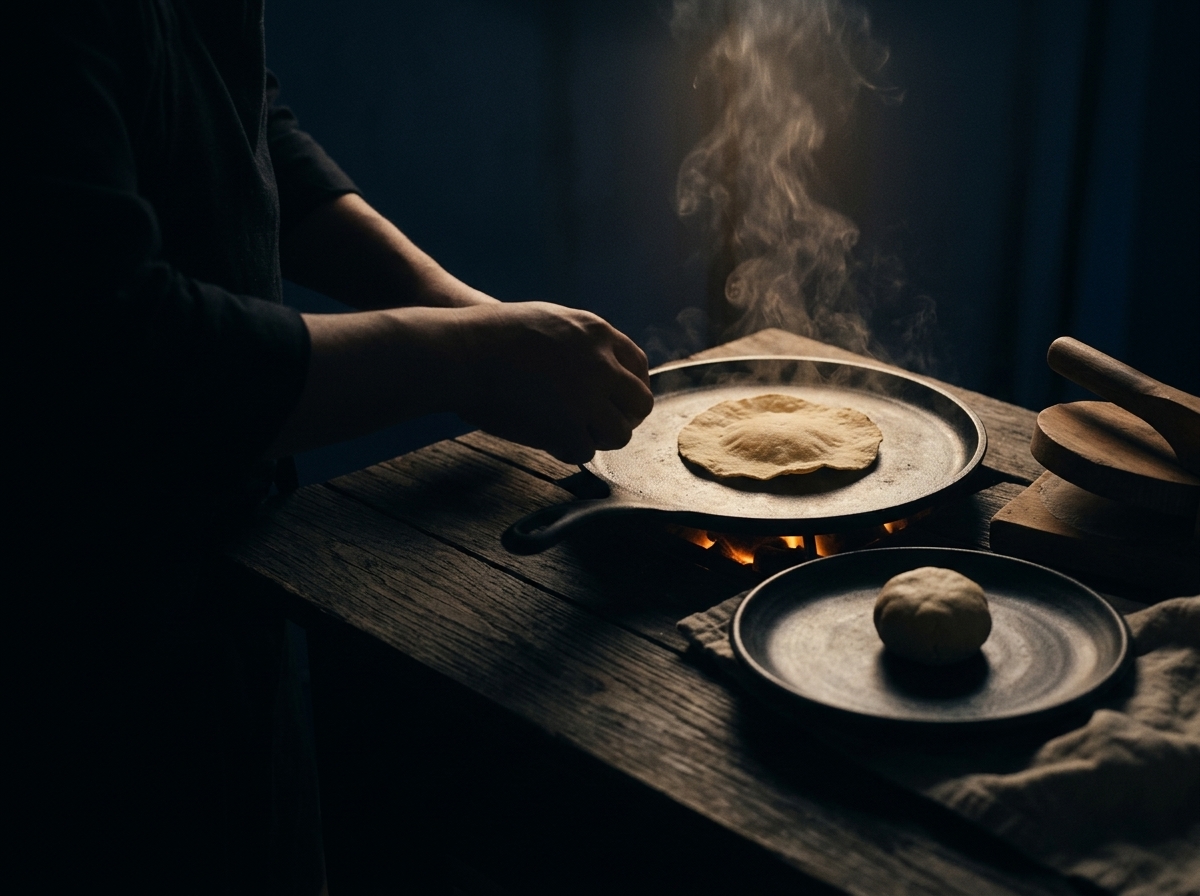
Once kneaded to a smooth sheen, the dough is portioned into small testales (masa balls) and kept under damp linen so it does not dry out before it reaches the heat.
Sixty Seconds on the Comal
The transformation from raw dough to hot, living tortilla happens in less than a minute.
The movement is swift and continuous. A testal is flattened into a thin, even disc and dropped immediately onto the dry heat of the comal.
In twenty seconds, the bottom edge seals and releases cleanly from the steel. A quick flick of the fingers delivers the first flip. Thirty seconds on the second side builds the golden, speckled foundation that gives the tortilla its structure. Then comes the final turn: with a gentle tap to the center, the trapped steam between the two cooked skins suddenly expands, ballooning the tortilla into a warm, fragrant pillow.
That sudden puff (el inflado) is the unmistakable mark of proper hydration and balanced heat. It leaves an inner pocket of tender, steamy corn protected by a paper-thin, lightly toasted crust.
The Living Center of the Table
When a fresh basket arrives at your table, tear one open. Catch the first wisp of sweet, toasted steam.
Fold it warm around slow-roasted Cochinita Pibil, letting the sweet corn cut through the citrus and charred achiote. Tear a piece to swipe through a deep Mole Poblano, watching the tender crumb drink up the dark reduction.
This is why a tortilla is served hot and never held. The thirty-five centuries of technique aren’t a museum piece—they are alive in the warmth of the basket right in front of you.
Join us this week at 120 River Street. Take a seat in the glow of the room, and taste what happens when heritage is given the time it deserves.